

The US midterms and fuel: what is already decided, and what is not
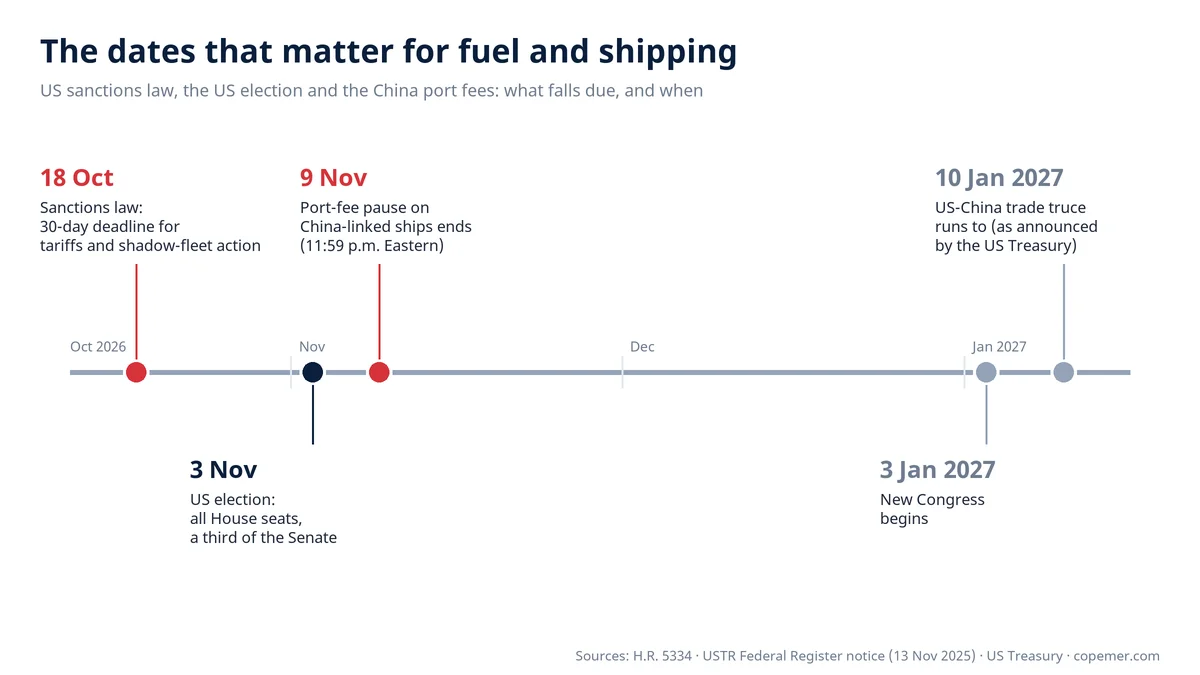
The US votes on 3 November. We cannot tell you who will win, and we will not try. What we can do is separate what is already decided from what is still open, because some of the decisions that matter most for fuel and shipping fall due around the vote, whoever wins.
Why fuel is in the picture
US regular gasoline averaged $4.354 a gallon in the week to 5 October, against $3.124 a year earlier: about 39% more. The US Strategic Petroleum Reserve held 283 million barrels in the week to 2 October, which Reuters reported as the lowest level since October 1982. On 29 September the Department of Energy offered to lend up to 40 million barrels more, with bids due on 6 October and deliveries in November and December.
Already decided: the Russia and Iran sanctions law
President Trump signed the Lindsey O. Graham Sanctioning Russia and Iran Act of 2026 (H.R. 5334) on 18 September. Its text sets a 30-day clock, which ends on 18 October:
- The President must raise duties on goods from Russia, including oil and gas, to a rate of up to 500%. - The President must also raise duties, up to 100%, on goods from the five largest buyers of Russian crude oil and gas that make new purchases, and from the five countries that do most to help Russia evade oil sanctions. - The President must review and act on foreign vessels used to move Russian oil, gas, coal, arms or other goods around sanctions, including ships without adequate maritime insurance or that evade the price cap, and on their owners, insurers, captains and the owners of foreign ports that serve them. Vessels identified are treated as blocked property. - The President can waive any of these measures by certifying in writing that it is in the national interest. - The law ends five years after signing. Its extension of the Iran Sanctions Act runs to 2031.
The law says "up to": the rates, the countries and any waivers are decisions still to be made. We screen counterparties against sanctions lists, and a law like this makes that screening more important, not less.
Still open: the port-fee pause
The US Trade Representative (USTR) has a Section 301 action against China's maritime, logistics and shipbuilding sectors. It includes fees on ships with Chinese owners or operators, on Chinese-built ships and on foreign-built vehicle carriers, and duties on certain Chinese cranes and cargo-handling equipment. The fees and duties are suspended from 10 November 2025 until 11:59 p.m. Eastern Standard Time on 9 November 2026. In its notice USTR said it would consider, before 10 November 2026, whether to continue the suspension or take further action.
On 23 September the US Treasury Secretary said the wider US-China trade truce would be extended to 10 January 2027. The port-fee suspension is set by USTR's own notice, and at the time of writing we have seen no new one. More than 200 trade associations asked USTR on 23 September to extend the pause.
What the election changes, and what it does not
On 3 November Americans elect all 435 members of the House and about a third of the Senate. The new Congress starts on 3 January 2027; until then the current one remains. The decisions above rest with the President and USTR, under laws and notices already in force. The result of the vote affects which new laws can pass and how closely the executive is questioned, not those deadlines.
What we do not know
Who will win. Which countries will be named under the new law, and whether any measure will be waived. Whether USTR will extend the pause. And what any of it does to fuel prices: we do not forecast that. If you are planning stems in US ports, or want to talk through counterparty and sanctions questions, ask us.
Sources: US Energy Information Administration, weekly retail gasoline prices (week to 5 October 2026) and weekly Strategic Petroleum Reserve stocks (week to 2 October 2026). Reuters via BOE Report, 29 September and 5 October 2026. H.R. 5334, enrolled bill (Division A), govinfo.gov; signing reported by The Hill and U.S. News (18 September 2026) and Baker McKenzie (21 September 2026). USTR, Notice of Modification of Section 301 Action: China's Targeting of the Maritime, Logistics, and Shipbuilding Sectors for Dominance, Federal Register, 13 November 2025 (FR Doc. 2025-19873); Holland & Knight, 'USTR Port Fee Suspension: What You Need to Know' (November 2025). US Treasury Secretary Scott Bessent, interview of 23 September 2026, as reported by Reuters and others.