

The MGO premium has more than doubled. Who ends up paying?
People sometimes tell me to stop worrying about world politics and stick to fuel. Prices go up, prices come down, the industry adapts. They are right that we adapt. But adapting often means passing the cost on, and that is why it does not stay with us.
What changed this year
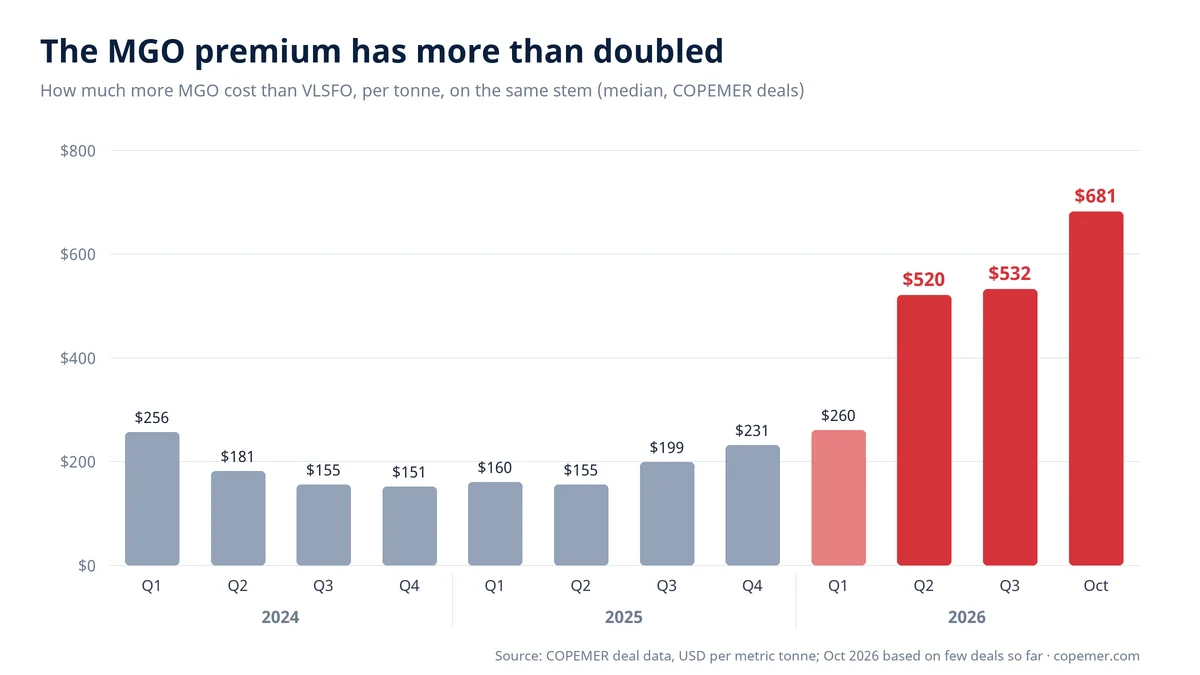
On the deals we brokered, a ship taking both grades on the same stem paid between $151 and $256 a tonne more for MGO than for VLSFO through 2024 and 2025 (the median per quarter, not weighted by volume). In the second quarter of 2026, during the disruption to traffic through the Strait of Hormuz, the median gap rose to $520. It was $532 in the third quarter, and about $680 on the few October deals so far. The conflict was not the only factor: refinery margins and local supply also move the gap.
The gap shows in published prices too: on 1 October, MGO in Rotterdam was $1,408.50 a tonne, against $700 for VLSFO.
Carriers added fuel surcharges within weeks
Fuel is one of the largest running costs of a ship, and the industry has long-established ways to pass it through: bunker adjustment factors, emergency surcharges, fuel clauses in charters. In this episode carriers used them within weeks.
Maersk announced an emergency bunker surcharge to apply from 25 March 2026: $200 per 20ft and $400 per 40ft container for dry cargo on its main long-haul (headhaul) routes, subject to regulatory approval in some markets. Reefers pay more.
Hapag-Lloyd added an emergency fuel surcharge of $160 per TEU for dry containers on its long-haul front-haul routes, for sailings from 23 March (from 8 April for cargo under US FMC rules).
CMA CGM applied $150 per TEU for dry containers on its long-haul headhaul routes from 1 August, as tensions around Hormuz flared again.
Other lanes, backhaul cargo and reefers were charged at different levels.
On short-sea routes, DP World's published ferry bunker surcharge for UK trailers (45ft container and trailer) went from €50 in April to €140 in May and June, was €119 in July and August, and was €140 again in September.
The Federal Reserve Bank of St. Louis modelled what the jump in VLSFO prices (from an average of $518 a tonne in February to $901 from March to May) means for a 21-day voyage from China to the US West Coast: the fuel cost per TEU rises from about $155 to $269 on ships up to five years old, and from about $360 to $626 on ships over 20 years old. It does not estimate how much of that reaches freight rates, which it notes depends on contracts, market conditions, capacity, demand and competition.
Then it can reach the shelf
Spread over the thousands of items in a container, a few hundred dollars looks small. But the ship is only one leg. The trucks that carry the goods onwards run on diesel, a distillate like MGO. Depending on contracts, competition and hedging, each link in the chain absorbs part of the cost and passes part of it on. Some of it can end up at the till.
When UNCTAD modelled the 2021 freight spike, it projected that if high container rates persisted, they would lift global consumer prices by about 1.5% by 2023, and by 7.5% in small island developing states, which depend heavily on shipping for their imports. That was a projection, not a measurement, and this year is not 2021. But it shows the direction, and who is most exposed: the places with the fewest alternatives to shipping.
Why it can outlast the headlines
Freight contracts, tenders and price lists agreed during a spike can carry it forward after the market eases. And in Europe part of the shift is structural, not only cyclical: from September 2028 the new North-East Atlantic ECA adds a large connected area to Europe's 0.10% sulphur waters, so more ships will need 0.10% fuel or a scrubber.
So yes, I will keep worrying about politics
A disruption thousands of miles away showed up in the prices we see every day, and in carriers' surcharges. How much of it reaches what families pay for food, clothes and heating, and when, is uncertain. But part of the bill can end up with the end consumer, who never sees a bunker invoice and is never asked.
Paying attention to the world is part of the job. It is how we help our clients buy at the right time, in the right port, and keep a little of that cost from travelling down the chain.
Sources: COPEMER deal data, January 2024 to October 2026 (median MGO minus VLSFO price per tonne on stems where the ship bought both grades, by quarter, not weighted by volume; October based on few deals). Ship & Bunker, Rotterdam prices, 1 October 2026. Maersk, Hapag-Lloyd and CMA CGM customer advisories (March and July 2026). DP World, ferry bunker surcharges (April to September 2026). Federal Reserve Bank of St. Louis, On the Economy, July 2026. UNCTAD, Review of Maritime Transport 2021.