
By 2028, Europe goes 0.10%. What it costs you, and where the gaps are
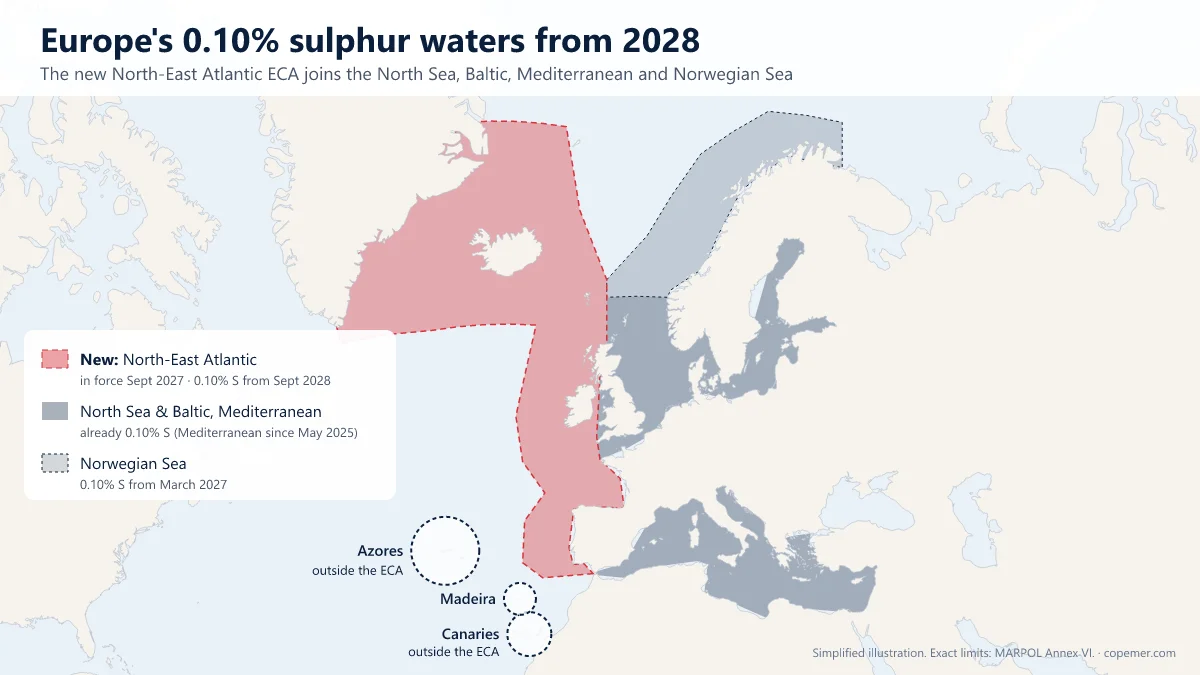
In 2026 the IMO adopted a new Emission Control Area covering the North-East Atlantic: the waters of Portugal, Spain, France, Ireland, the UK, Iceland, the Faroe Islands and Greenland that are not already in an ECA. It enters into force on 1 September 2027, and the 0.10% sulphur limit applies from 1 September 2028.
On its own, that is one more zone on the chart. Put it next to the others and the picture changes. The North Sea and Baltic have been ECAs for years, the Mediterranean became one in May 2025, and the Norwegian Sea, an ECA since March 2026, moves to 0.10% in March 2027. From September 2028 these areas join up into one connected 0.10% area, from the Mediterranean through the Atlantic and the North Sea to the Baltic and the Norwegian Sea. In these waters, 0.50% VLSFO can no longer be burned unless the ship has an approved scrubber.
What it actually costs
On the 19 stems we brokered between July and October 2026 where a ship took both grades, MGO cost a median of $560 per tonne more than VLSFO (the middle value across stems, not weighted by volume). The gap ranged from about $170 to $765 depending on port and timing. Measured the same way, quarter by quarter, it was between $151 and $256 through 2024 and 2025.
Take a ship without a scrubber, burning 20 tonnes a day and spending three days per voyage in waters that become ECA in 2028. If it switches those 60 tonnes from 0.50% VLSFO to MGO, at a $560 spread that is around $34,000 more per voyage, and over $330,000 for ten voyages a year. MGO is not the only way to comply: ULSFO, LNG or an approved scrubber also meet the rule, each at a different cost. Either way, owners and charterers should be pricing it into charters and freight now, not in August 2028.
The waters that stay outside
The zone excludes the waters around the Canary Islands, Madeira and the Azores. Ships operating there are not bound by the new 0.10% limit: at sea around the islands the global 0.50% limit applies. A ship coming from these waters must still have finished its changeover before it enters any ECA.
What tends to go wrong
Switching to distillates is not just a purchasing decision.
Changeover: the switch must be completed before entering the zone, and recorded in the logbook as MARPOL Annex VI requires. Allow enough time for the fuel in the system to be flushed through.
Viscosity: MGO is far thinner than VLSFO. Older engines and fuel pumps may need coolers to keep viscosity at the engine inlet above the minimum set by the engine maker, which differs from one engine to another. Check yours.
Cold weather: the cold-flow properties of a distillate matter in winter. Ask for the cloud point and cold filter plugging point on the specification, not only the pour point.
Compatibility: avoid mixing deliveries of different fuels in the same tank unless a compatibility test says it is safe.
Availability: at some smaller Atlantic ports, 0.10% fuel may only be available by truck rather than barge, in smaller quantities and with less flexible timing. It varies from port to port, so plan stems further ahead.
What to sort out now
Time charters signed today can still be running in 2028. Make sure they say who supplies ECA-compliant fuel, who pays for the changeover, and how fuel left on board is valued at delivery and redelivery.
Ships with an approved scrubber can keep burning higher-sulphur fuel in the zone, but some ports and countries restrict open-loop washwater discharge, which can limit how the scrubber is used. The economics depend on the spread between HSFO and MGO, which is worth reviewing with real port prices rather than averages.
If you would like to know what 0.10% fuel costs in the ports you call, and how deliveries work there, ask us. We compare every available supplier and come straight back to you.
Sources: IMO MEPC 84 (2026); DNV, "North-east Atlantic joins the expanding network of ECAs" (2026); DNV, "New ECAs for the Canadian Arctic, Norwegian Sea and North-East Atlantic Ocean" (2025). Price figures: COPEMER deal data, all ports: the median difference between the MGO and VLSFO prices on stems where the ship bought both grades (19 stems from July to October 2026), not weighted by volume.